



Collecting as an alternative investment
Collecting as an Alternative Investment
People have surrounded themselves with beautiful objects since ancient times. This is where the origins of collecting can be traced. The earliest forms of collecting were the art collections of royal families, nobility, and pontiffs. These collections, however, were accessible only to a narrow group of people, while the general public had very limited access to them.
The event that gave rise to modern collecting was the issuance of the first postage stamp in 1840. The postage stamp possessed several attributes that made it an ideal collectible: it was interesting, affordable, widely distributed, represented monetary value, and symbolized the country that issued it.
People began gathering used stamps, exchanging them, and cataloguing them. This is how philately emerged — still the most widespread collecting field today. Alongside it, numismatics developed, focusing on the collecting of coins. Although money was invented long before postage stamps, modern numismatics began to flourish around the same time as philately.
Collectors driven by passion started expanding, exhibiting, and promoting their collections. Naturally, this increased the demand for collectible items, which gradually became a way to store financial value.
Philately
There are several reasons to collect postage stamps. Besides the joy it brings, philately is one of the best-catalogued collecting fields. The first catalogues appeared shortly after the first stamps were issued, and today practically every stamp is recorded in one of the major world catalogues (MICHEL, YVERT, SASSONE, UNIFICATO).
Good cataloguing makes it easy to determine the value of a stamp and track price developments. When selecting stamps, it is wise to balance emotions with rational thinking — not everything that looks appealing is also valuable.
If you are just starting with philately, we recommend reading the article Filatelia – predaj známok a rady pre zberateľov, which offers practical tips for choosing and purchasing stamps.
Recommendations for philatelists:
- focus on one country, period, or theme,
- collect stamps in excellent condition,
- verify authenticity and obtain certificates for valuable stamps,
- buy from trusted sellers,
- follow trends — even philately has its “fashion waves”.
For safe storage and clear organization of stamps, we recommend high-quality stamp stockbooks. Both beginners and advanced collectors will also benefit from up-to-date philatelic catalogues, which help identify values and variations.
For more information on proper stamp storage, see the article Nechajte známky dýchať – správne zásady archivácie.
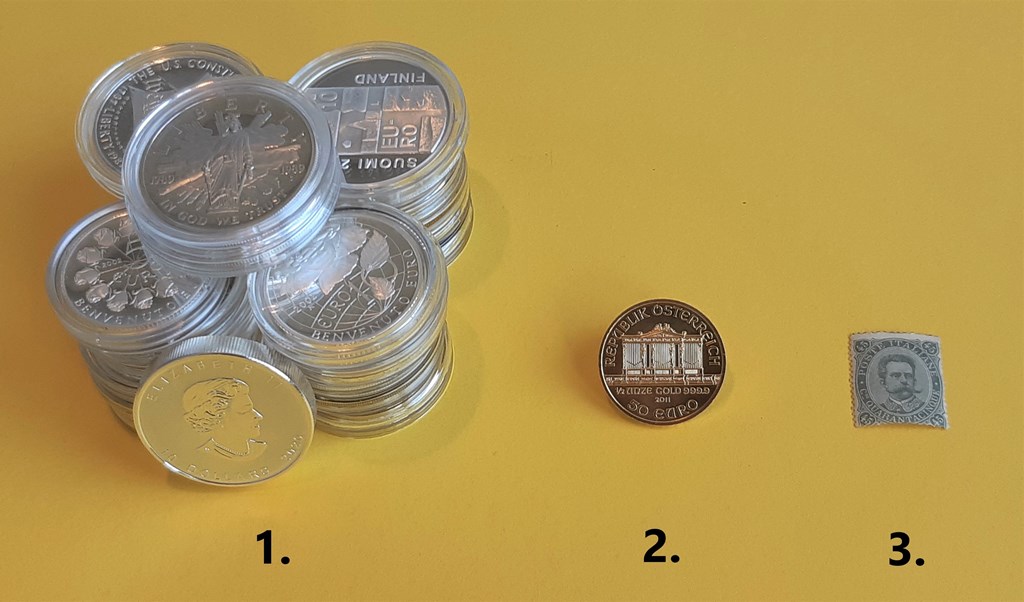
Fig. 1: Comparison of the volume of investment silver (1), gold (2), and philately (3) worth approx. 1,000 EUR.
Numismatics
Numismatics has one major advantage over philately — coins always retain at least the value of the metal they are made of. This gives them better liquidity.
Recommendations for numismatists:
- focus on one country, region, or historical period,
- for modern coins, prefer the highest quality grades (PROOF, PROOFLIKE),
- in the long term, high-quality coins have greater appreciation potential than common ones (UNC, U, BU).
A specific phenomenon is euro coins. Despite initial doubts, their popularity continues to grow. The reasons are their uniformity, wide circulation, and symbolic value for each eurozone country.
Both philatelists and numismatists benefit from various collector tools, such as magnifiers, tweezers, and protective sleeves.
Conclusion
When stamps or coins are collected wisely, there is a high chance that the invested money will appreciate better than in many financial institutions. The 180-year history of collecting only confirms this.
If you want more useful advice for philatelists, we also recommend the articles Filatelia – predaj známok and Nechajte známky dýchať.
The joy of building your own collection, however, is a value that cannot be measured in money.
Photo No. 1 used in this article – private collection of the author.